
Skaraborg, West Sweden: branded public WiFi and visitor analytics across an entire tourism region
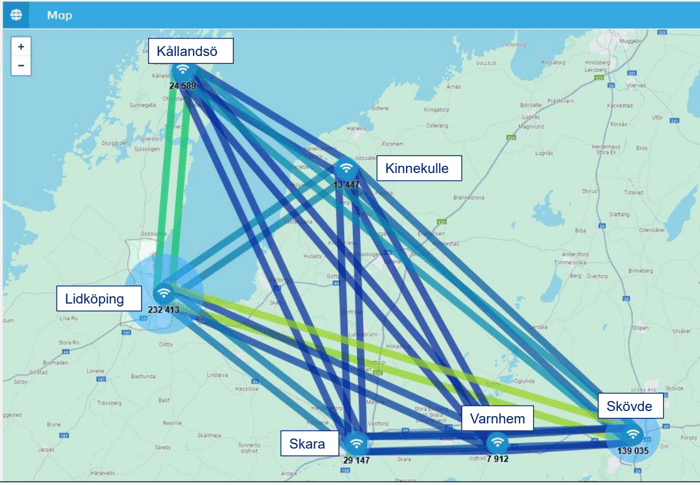
How a group of municipalities between lakes Vänern and Vättern turned public WiFi into a shared measurement tool — comparing visitor flows across castles, nature sites and city centres with one consistent methodology.
The Skaraborg area gathers some of West Sweden's most-visited destinations: Läckö Castle and the Kållandsö peninsula, the Kinnekulle plateau, the historic abbey village of Varnhem, and the city centres of Lidköping, Skara and Skövde. The municipalities wanted a common way to understand how many people visit each destination, how long they stay, and how visitors move between sites — while each destination keeps its own local brand towards WiFi users.
The challenge: measuring tourism where ticket gates don't exist
- Open-air destinations: harbours, bathing spots, viewpoints and market squares have no entrance — traditional visitor counting simply doesn't apply.
- A regional picture: the municipalities needed comparable figures across very different sites, plus insight into how visitors circulate between destinations.
- Local identity: each municipality — Lidköping vid Vänern, Götene, Skara, Skövde — wanted its own look and feel and its own message when visitors connect.
- From connection to conversation: free WiFi should do more than connect people; it should channel visitors towards local information, offers and surveys.
The solution: one regional platform, local branding everywhere
WiFi and visitor-flow measurement across 14 areas
A shared WiFi and tracking network covers the region's key destinations: three areas on Kållandsö (including Läckö Castle and Spiken fishing harbour), four on Kinnekulle, the Varnhem abbey area, Skara city centre, Lidköping city and two areas in Skövde. Every month, each destination receives a report covering passing-by traffic, dwell time, month-on-month change and year-on-year comparison — plus a movement map showing visitor flows between destinations.
A branded portal for every place
Each municipality has its own captive portal design, and every individual location can carry its own look and feel. Printed flyers and window decals promote the local network name — "Skövde WiFi" and its counterparts across the region — turning the WiFi service itself into a visible part of the destination brand.
WiFi-2-Web: turning WiFi users into web visitors
When a user connects and taps "Continue", they are directed to a web page chosen by the municipality or venue — for example the destination page for Skövde city centre — or to a temporary page, such as a visitor survey. WiFi users become web visitors, giving each destination a direct communication channel at the exact place where people are standing.
The result: a monthly pulse on regional tourism
The July 2026 report illustrates what the platform delivers. Summer visitation surged at the nature and heritage sites — Varnhem doubled versus June — while the city centres showed their typical holiday-season dip, all captured in one consistent dataset:
| Destination | July 2026 | June 2026 | Month | Year |
|---|---|---|---|---|
| Kållandsö (3 areas) | 57,606 | 34,243 | +68% | −9% |
| Kinnekulle (4 areas) | 28,052 | 16,463 | +70% | −16% |
| Varnhem (1 area) | 15,989 | 7,912 | +102% | n/a |
| Skara Centrum (1 area) | 27,170 | 29,147 | −7% | +7% |
| Lidköping City (1 area) | 181,014 | 187,622 | −3% | +19% |
| Skövde City (2 areas) | 129,009 | 149,280 | −14% | n/a |
| Total | 438,840 | 424,667 | +3% | — |
Down to site level, the reports reveal where growth happens: Läckö Castle rose from 15,494 to 24,330 visits in a month, Spiken fishing harbour from 14,555 to 25,990, and the Kinnekulle viewpoint tower more than doubled. Dwell time is measured too — visitors spend on average 1h46 on Kållandsö, against a 47-minute regional average.
Objective, comparable visitor data — every month, for every destination — replacing guesswork in tourism planning, event evaluation and investment decisions.
With the same platform now proven across nature sites, heritage destinations and city centres, the Skaraborg municipalities have a shared language for talking about tourism — and a communication channel that reaches visitors precisely where they are.
