
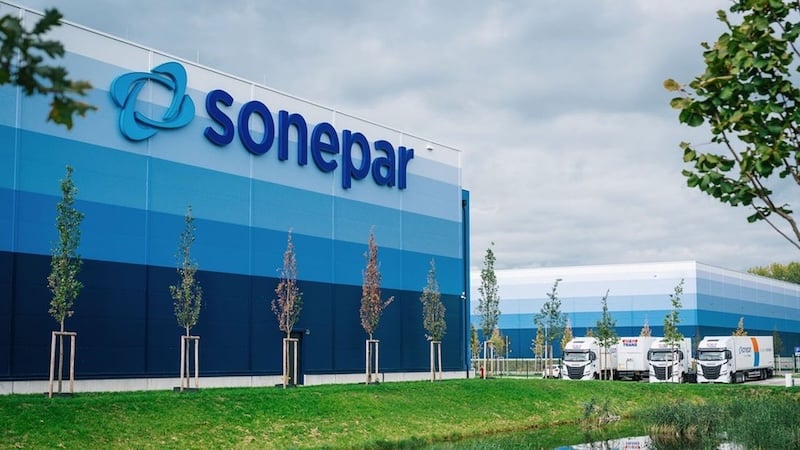
Wifirst co-manages the WiFi and WAN networks at the six logistics hubs of Sonelog, Sonepar France’s distribution network. In total, 554 WiFi hotspots, six dedicated fibre WAN lines and 24/7 monitoring underpin a demanding commitment: to deliver over 4 million orders a year on the same day or the next day, anywhere in France. What makes this model unique is that Wifirst does not replace Sonelog’s teams, but rather reinforces them.
co-managed logistics platforms
WiFi terminals under supervision
peak number of connected devices
orders per year delivered on the same day or the next day
Who is Sonelog, Sonepar France’s logistics network?
Sonelog is the logistics network of Sonepar France, a joint global leader in the B2B distribution of electrical equipment. Through six shared distribution centres located across the country — Saint-Quentin, Châteaubourg, Fleury-Mérogis, Cestas, Le Pontet and Plaine de l’Ain — Sonelog fulfils more than 4 million orders a year, with a commitment to same-day or next-day delivery throughout France. Each platform covers a large region and a specific catchment area: Châteaubourg alone serves 16 departments in the West, covering an area of 24,000 m² and holding 25,000 stock items.
Sonelog is committed to a rigorous approach to operational excellence and environmental responsibility: the network achieved ISO 50001 certification (energy management) in 2021 and ISO 14001 certification (environmental management) in 2023 across its entire scope — a strong indication of the industrial maturity and CSR of Sonepar’s supply chain.

The challenge: how can a critical network be industrialised without losing control of it?
In B2B logistics, WiFi is no longer simply an IT support issue: it is an integral part of the production process, just like a stacker crane or a loading bay. A fifteen-minute outage in the order preparation area can result in tens of thousands of euros in order delays and contractual penalties.
Faced with this critical issue, logistics operators have historically favoured managing their wireless networks in-house: this allows them to retain control, expertise and the ability to manage response times. Outsourcing the entire network to a third-party operator has long been seen as taking a risk with a vital supply chain asset.
For Sonelog, which delivers tens of thousands of product lines to thousands of business customers on a same-day or next-day basis, the challenge was particularly demanding:
- Operational criticality 24/7 at sites operating on a shift basis — goods receipt, putaway, picking, packing and dispatch.
- A structurally hostile radio environment: high ceilings, densely packed metal racks, narrow aisles, and a layout that changes as stock arrives.
- A wide range of critical business applications: radio frequency terminals (PDAs, handheld scanners), terminals fitted to forklift trucks, voice picking, IoT sensors, CCTV, and building management systems.
- High cybersecurity standards, in a sector where regulatory pressure (NIS2) and business continuity requirements are rising rapidly.
- A multi-site network to be managed in a consistent manner, without compromising on local presence and responsiveness.
The challenge: to find a model that offers the industrial scale and expertise of a network operator, without depriving Sonelog of its production facilities.
The solution: a co-management model, not standard WiFi as a Service
“Wifirst does not set out to replace in-house teams: it strengthens them.”
Unlike the traditional ‘fully managed’ approach, Wifirst has developed a co-management model with Sonelog that draws on the staff already based at the sites. It is the Sonelog teams – trained and equipped by Wifirst – who carry out day-to-day maintenance operations on site, such as replacing a hotspot, providing first-level support and carrying out physical checks. Wifirst retains responsibility for design, radio engineering, 24/7 monitoring and end-to-end contractual liability.
This division of responsibilities is not a cost-saving measure in disguise: it is a choice of operational architecture. When an incident occurs in a warehouse, what counts is the time it takes for someone to physically access the equipment. Calling on Sonelog technicians who are already on site, rather than a Wifirst technician who has to travel, saves hours of productivity — and ensures we meet the same-day or next-day service commitment.
Across the six platforms, Wifirst operates a managed WiFi infrastructure and a dedicated WAN network, designed as a high-availability production infrastructure:
- Industrial WiFi coverage, tailored to each site following a radio audit under real-world conditions — that is, after partitions and racks have been installed and with a storage level representative of actual operations. The placement of access points is never validated on the basis of plans alone.
- An architecture prioritising the 5 GHz band, to provide RF terminals (handheld scanners, PDAs, in-vehicle terminals) with the most stable and high-performance band — with a mesh network tailored to the specific type of B2B warehouse.
- A converged, multi-service LAN that connects every site and carries business traffic (WMS, RF terminals, voice picking), IoT traffic, CCTV and telephony over a single network — with strict segmentation by VLAN and prioritisation of critical traffic.
- A WAN operated in-house by Wifirst, with a dedicated fibre line at each site — providing business-grade internet connectivity, monitored 24/7 and backed by measurable contractual commitments.
- Centralised multi-site monitoring via the Wifirst Center platform, accessible to both Sonelog and Wifirst teams — a unified, real-time view of the six platforms, network status, WiFi performance and usage statistics by site.
- Ongoing knowledge transfer to Sonelog teams: up-to-date documentation, monitoring access, first-level support procedures and dedicated training on best practices for maintenance.
- A roll-out whilst the site remains operational: CACES-certified technicians for installation at height using aerial work platforms, detailed planning with the operations teams, and a shared risk prevention plan. The installation is carried out without disrupting warehouse operations.
Sonelog network performance in key figures
The Wifirst partnership now covers the entire Sonelog network with a standardised infrastructure, operated as a single multi-site system:
- 6 logistics hubs managed by Wifirst: Saint-Quentin, Châteaubourg, Fleury-Mérogis, Cestas, Le Pontet, Plaine de l'Ain
554 WiFi hotspots in operation across the entire network — with 100 per cent uptime - 6 in-house-operated fibre WAN lines, one per logistics hub
- Over 1,300 devices connected simultaneously at peak times — RF terminals, PDAs, scanners, embedded business devices
- An average of 2,518 unique devices per month over the last 12 months
- 88.8 per cent of devices on the network are mobile — typical of a warehouse environment with radio-frequency terminals and hands-free devices
- 93.1 per cent of browsers are in French — the connected user base consists mainly of Sonelog staff
A network used almost entirely for bussiness, with minimal visitor traffic
Unlike most B2C or hospitality environments, the Sonelog network is, by its very nature, a production network. Over a 12-month period, more than 76 per cent of WiFi traffic is consumed by business-specific SSIDs — WMS, RF terminals, embedded devices, telemetry — whilst the guest network (carriers, external service providers) remains marginal, at around 23 per cent. This breakdown reflects the absolute priority given to operational data flows and illustrates the industrial maturity of the Sonelog system.
Data usage remains steady throughout the year — between 10 and 17 TB per month — with no marked seasonal fluctuations, unlike in the outdoor accommodation or student accommodation sectors. This is characteristic of a network that is primarily used to keep the warehouse running, day in, day out, over the long term.
Co-management: striking the right balance between the operator and the client
The co-management model established with Sonelog is changing the nature of the partnership. Wifirst does not step in to replace in-house teams: Wifirst strengthens in-house teams by providing what they are not equipped to handle on their own — radio engineering, R&D, technology watch on successive WiFi standards, 24/7 monitoring via a Network Operations Centre, and contractual responsibility for availability.
Conversely, Sonelog retains control over matters requiring local presence and immediate responsiveness: first-level support, physical replacement, coordination with operations teams, and business-related decision-making. It is this clear division of roles that makes the arrangement sustainable in the long term, across a multi-site infrastructure of this scale.
Governance remains deliberately streamlined: a single point of contact at Wifirst for all six platforms, a single point of entry for any incident, and consistent technical standards across all sites. Standardisation at group level, responsiveness at site level.
Wifirst’s commitment to cybersecurity is also underpinned by ISO 27001 certification, a key asset at a time when the NIS2 Directive is extending cybersecurity obligations to critical actors in the supply chain. For Sonelog, this provides a foundation for compliance that simplifies regulatory management across the entire logistics network.
The results
Today, Sonelog’s six platforms benefit from a standardised connectivity infrastructure, monitored 24/7 and co-managed across the network — a technical foundation supporting the WMS, RF terminals, IoT data streams and all of Sonepar’s supply chain business applications. This system directly supports Sonelog’s operational commitment: to deliver same-day or next-day on over 4 million orders a year, without any stock-outs, across the whole of France.
Beyond raw performance, the partnership with Wifirst gives Sonelog the means to confidently adapt to future developments — the widespread adoption of voice-picking systems, the roll-out of wearables, the gradual integration of autonomous mobile robots (AGVs/AMRs), and the rise of connected business devices. The network is designed not for yesterday’s applications, but to cope with those of tomorrow, without having to rebuild everything from scratch when the next technological leap occurs.
For Wifirst, this partnership with one of France’s largest B2B distributors demonstrates its ability to operate critical multi-site infrastructure in joint management with logistics departments — a model aimed at supply chain players who wish to scale up their operations without relinquishing control over their production facilities.
Frequently Asked Questions
What is Wifirst’s WiFi co-management model?
Co-management is a model in which Wifirst is responsible for the design, radio engineering, 24/7 monitoring and contractual liability for the network, whilst the client’s teams — trained and equipped by Wifirst — carry out first-level maintenance work on site. This division of roles speeds up incident resolution times whilst allowing the client to retain control over its production facilities.
How many Wifirst WiFi hotspots does Sonelog operate?
Wifirst operates 554 live WiFi hotspots across Sonelog’s six logistics hubs, with a 100 per cent uptime rate, supplemented by six dedicated fibre WAN lines (one per site).
Why is WiFi so crucial in a logistics warehouse?
In B2B logistics, WiFi forms part of the production infrastructure: it carries data streams from radio frequency terminals, voice picking systems, the WMS and connected devices. An outage lasting just a few minutes in the order preparation area can lead to order delays and contractual penalties amounting to tens of thousands of euros.
How does Wifirst meet the NIS2 cybersecurity requirements?
Wifirst’s commitment to cybersecurity is underpinned by ISO 27001 certification and strict segmentation of traffic via VLANs. For a supply chain operator subject to the NIS2 Directive, this provides a consistent foundation for compliance across all sites.
