
The 8 Warehouse Operations That (Truly) Depend on Connectivity

In a modern logistics warehouse, WiFi is no longer a comfort — it is a critical production infrastructure. A fifteen-minute network outage in the picking area can lead to tens of thousands of pounds in delays and contractual penalties from shippers. To understand why, you need to look closely at the operations that set the pace of daily life in a logistics site. Here are the 8 core operations that depend directly on reliable wireless connectivity, and what happens when it fails.
1. Acceptance: the entry point for the supply chain
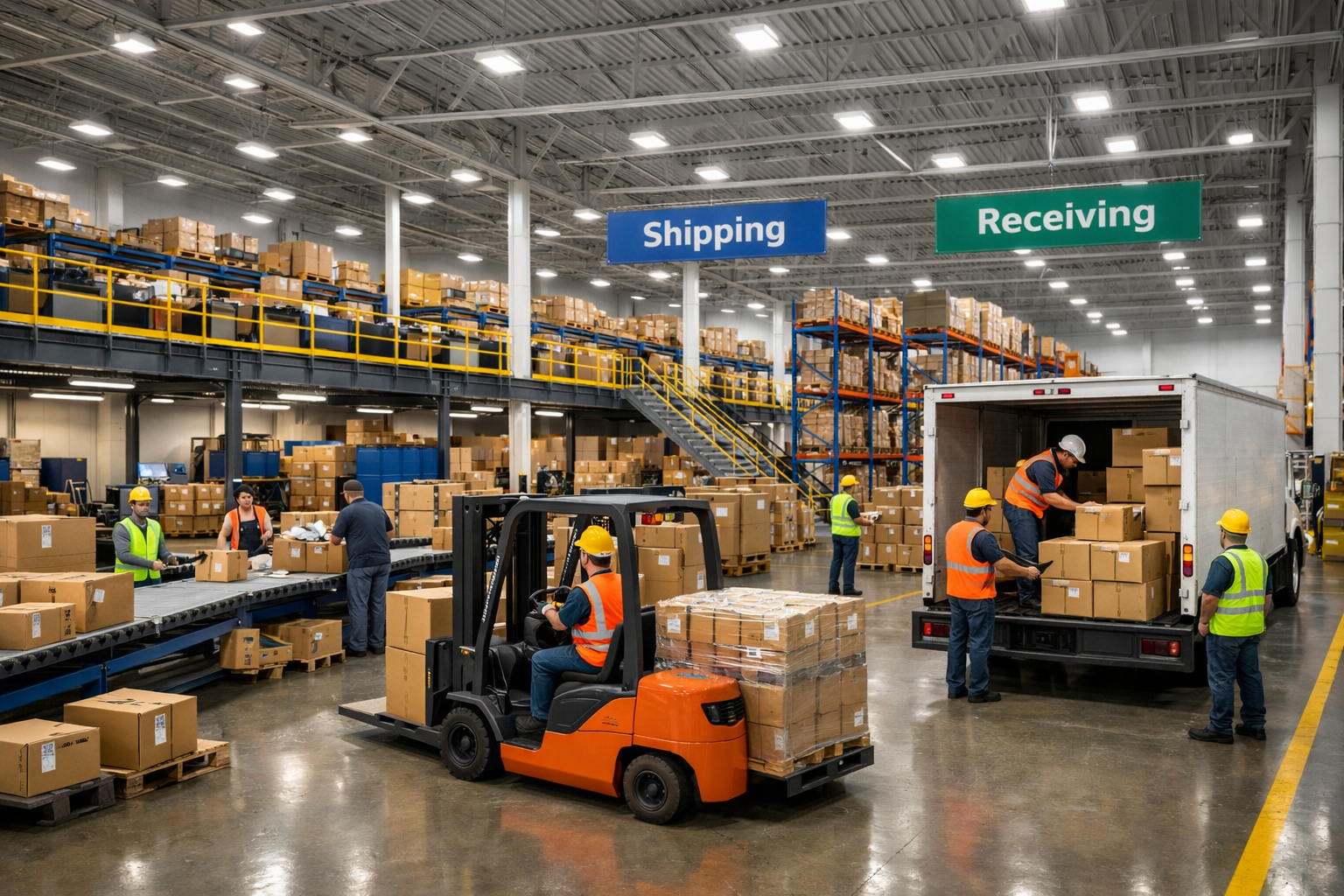
It all starts at the loading bays. When a lorry arrives, the receiving clerk scans the pallets one by one using a radio-frequency terminal (PDA, handheld scanner), checks that they match the Advanced Shipping Notice (ASN) sent by the supplier, and then assigns each pallet to a storage location or a cross-docking area in accordance with the WMS rules.
Why the network is critical: each scan triggers a real-time exchange with the WMS to validate the item reference, check the quantity and allocate a storage location. A loss of connectivity at the loading bay forces the operator to halt the reception process or to operate in a degraded mode (using paper records, followed by manual data entry), with a risk of stock errors and immediate congestion at the loading bays — which has a knock-on effect on the entire day’s operations.
2. Stocking: the right product in the right place
Once received, the pallet must be moved to its storage location. The forklift operator, using a handheld terminal fitted to their forklift, follows the instructions from the WMS, which indicates the optimal location based on defined slotting rules (ABC rotation, weight constraints, grouping by supplier, etc.). On arrival, they confirm the put-away by performing a double scan: scanning the location, then scanning the pallet.
Why the network is critical: without a network connection, confirmation of the location scan is not sent back to the WMS. Stock levels become inconsistent within minutes. The operational risk is twofold: physically misplaced pallets, and a mismatch between theoretical and actual stock levels. This subsequently leads to inventory discrepancies — which are costly to rectify and can give rise to disputes.
3. Picking: the heart of the supply chain
This is the most demanding and value-generating operation in a warehouse. Order pickers receive picking tasks on their terminals from the WMS: to retrieve a specific product, in a specific quantity, from a specific location. Each item picked is validated by scanning, which updates the stock levels in real time and feeds the picking list.
Depending on the warehouse’s profile, order picking can be carried out using various technologies:
- Picking-by-light: light modules indicate the location of the item to be picked and the quantity
- Voice picking: the order picker receives their tasks via a headset and confirms them verbally
- Wearables: scanner rings and smart glasses for hands-free picking
- Goods-to-person: robots (AGVs/AMRs or systems such as Exotec) bring the products to the stationary order picker
Why the network is critical: all these technologies are in constant communication with the WMS via WiFi. Even a brief interruption can freeze a task in progress, cause a pick to be invalidated, or desynchronise the goods-to-person station from its fleet of robots. On a peak day (Black Friday, sales, special promotions), even a moderate deterioration in network performance can result in a 10–20 per cent loss in productivity — which is directly reflected in the number of orders prepared that day.
4. Voice picking: a problem extreme downtime
Voice picking deserves a special mention. The order picker, equipped with voice-recognition headphones, receives brief instructions (“aisle 12, bay 4, pick 3 units”) and confirms them verbally (“3 picked”). The interaction is constant, brief and frequent — several hundred exchanges with the server per hour.
Why the network is critical: beyond the (modest) data rate, it is latency and the stability of roaming that are decisive. If the headset switches between Wi-Fi access points (as the order picker is constantly on the move), the transition must be imperceptible — a few tens of milliseconds at most. An interruption lasting more than a second disrupts the workflow and may force the order picker to repeat a task. The Vocollect, Honeywell and Zebra headsets used in France are particularly sensitive to this switching between access points.
5. AGVs and AMRs: the fleet that never sleeps
Automated Guided Vehicles (AGVs, guided by floor markings or rails) and Autonomous Mobile Robots (AMRs, which operate autonomously using LIDAR mapping) are playing an increasingly important role in automated warehouses. They transport pallets, bins or entire racks between zones, operating as a fleet coordinated by an orchestrator (WCS — Warehouse Control System).
Why the network is critical: an AGV that loses its Wi-Fi connection with its orchestrator comes to an immediate, safe halt. A chain reaction of stoppages across the fleet can bring an entire zone to a standstill, or even the whole site in highly automated operations. The acceptable latency for this equipment is typically less than 100 ms, with seamless roaming required at all times. This is the most technically demanding application in a warehouse, and it is also the one that has driven the maturity of Wi-Fi 6/6E/7 in new or refurbished sites.
6. Packing and quality control: the final stage before dispatch
Once the order has been prepared, it moves on to the packing stage: weighing to check it matches the packing list, a visual quality check, carrier labelling, and the generation of the delivery note. This stage uses less system resources than picking, but it is essential for end-to-end traceability.
Why the network is critical: each parcel generates several interactions with the WMS, the TMS (Transport Management System) and sometimes directly with the carriers’ systems (DHL, Chronopost, Colissimo) to retrieve the dispatch label. A network outage in the packing area creates a bottleneck just before dispatch — precisely the moment when the contractual cut-off commitment is most critical.
7. Dispatch: the commitment to the shipper
At dispatch, parcels are allocated to delivery rounds, scanned one last time to confirm loading, and linked to a consignment note. Depending on the organisation, scanning takes place at the loading bay (using a handheld terminal or barcode scanner) or directly on the conveyor belt (using RFID readers or fixed scanners).
Why the network is critical: this is where compliance with contractual commitments to shippers and end customers is validated (end-of-day cut-off times, next-day delivery slots, etc.). A site that is unable to dispatch on time due to a network incident faces direct penalties — and reputational risk with shippers, which is particularly critical for a multi-tenant 3PL.
8. Stocktaking: the truth about stock levels
Inventory can be annual (a full count) or rolling (a partial, cyclical count, which is more modern and less disruptive). In either case, operators walk through the warehouse with an RF terminal, scan the storage locations and their contents, and report any discrepancies to the WMS.
Why the network is critical: unlike the real-time processes described above, stocktaking is planned and is more resilient to network degradation. However, the quality of Wi-Fi coverage in deep storage areas (the rearmost aisles, mezzanines, upper racks) determines the speed and reliability of the operation. A stocktake that drags on ties up staff, disrupts operations and is costly.
Quick reference table: network requirements by operation
| Operation | Overriding requirement | Impact of a power cut |
|---|---|---|
| Acceptance | Availability at the quay | No further entries, congestion on the platforms |
| Placing in stock | Radio coverage in the aisle | Stock desynchronisation |
| Picking | Cross-network roaming, constant data speed | 10–20 per cent drop in productivity |
| Voice picking | Low and stable latency | Disruption to the routine, loss of purpose |
| AGV / AMR | Latency < 100 ms, seamless roaming | Cascading fleet shutdown |
| Packing | Availability, TMS integrations | Goulet avant expédition |
| Delivery | Availability at the cut-off date | Penalties for shippers |
| Inventory | Coverage in deep areas | A stock-take that drags on |
What this reveals about a warehouse’s network
These eight operations share four common requirements that form the basis of the network architecture expected in a modern warehouse:
- Systematic 5 GHz coverage across the entire site, and ideally 6 GHz (WiFi 6E) in the densest areas or in automated environments.
- Seamless roaming between access points — order pickers, forklift operators and robots can move around freely at all times. The 802.11k, 802.11v and 802.11r standards play a key role in ensuring this continuity.
- High contractual availability (typically 99.5 per cent or more annually) with a guaranteed restoration time (GRT) of no more than 4 working hours at critical sites. It is this commitment that makes Wi-Fi a serious consideration for the IT department.
- Proactive 24/7 monitoring by a Network Operations Centre (NOC) capable of detecting performance degradation before it becomes an incident — rather than waiting for users to complain before taking action.
This is also why an increasing number of logistics departments and IT departments are opting for models operated and co-managed with industrial Wi-Fi specialists, rather than managing the network in-house with generalist IT teams. The subject has become too specialised and too critical to be treated as a standard office IT sub-project.
Further reading — To explore the specific challenges of warehouse connectivity in greater depth, see our strategic guide to logistics warehouse connectivity. You can also find out more about our WiFi solutions for warehouses or read our article on the3PL/4PL/5PL classification, which explains the different levels of outsourcing and their implications for networks.
- Wifi (43)
- Hotel Industry (18)
- Digital Workplace (14)
- Behind the scenes (8)
- IPTV - Signage (8)
- Optical fibre (7)
- Retail (7)
- Green-IT (5)
- Education (3)
- Healthcare (2)
- PBSA (2)
- Cybersecurity (1)
- General (1)
- Hospitality (1)
- Student Accommodation (1)
- Telephony (1)
- Tips and tricks (1)
- Tourism (1)
- Warehouse & Logistics (1)
- Wifirst (1)
You May Also Like
These Related Stories
3PL, 4PL, 5PL: Understanding Logistics Terminology

2020 brand campaign