

When Guest WiFi Becomes a Legal Liability
Providing WiFi access to customers, visitors or residents is no longer a differentiator; it is a basic expectation for comfort and service quality. Yet in the UK and across Europe, operating a public or corporate WiFi network – even when offered free of charge – entails strict legal obligations around security and the protection of personal data.
At the centre of these obligations is the WiFi captive portal – the authentication page that governs access to your network. Beyond its roles in management, security and marketing, it is now a critical control point for complying with the General Data Protection Regulation (GDPR) and data retention laws such as the UK Investigatory Powers Act 2016.
This guide sets out the legal challenges of guest WiFi in 2026, the best practices to implement, and the key criteria for ensuring your network remains fully compliant.
I. WiFi Captive Portals: A Core Component of Compliance
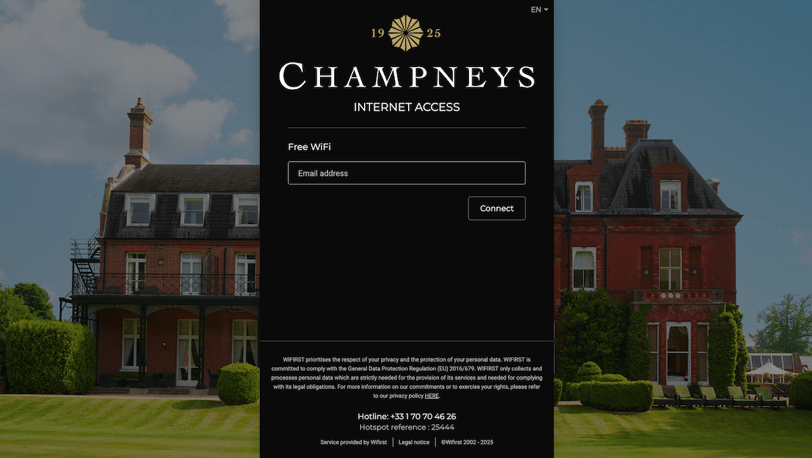
A WiFi captive portal is the web page to which users are automatically redirected when they try to join a WiFi network. Its core purpose is to manage and secure access, but in a compliant environment it must also fulfil three essential functions:
1. Secure Authentication
It identifies the user (via email, SMS, social login, or a unique code) and isolates each session to prevent cross-user hacking or data leakage.
2. Capturing Consent
The portal is the primary interface for capturing explicit user consent to:
- The Terms and Conditions (T&Cs) of use,
- The Privacy Policy (how their data will be used).
3. Legal Traceability
Connection data (logs) required for legal traceability is captured at this stage, in line with regulations so that information can be provided to law enforcement if requested.
II. The Two Legal Pillars of Public WiFi
Any WiFi network offered to the public (customers, visitors, residents or employees) must comply with two complementary legal frameworks: data retention regulations (anti-terrorism and anti-crime) and data protection laws (GDPR).
1. Retention of Connection Logs (Investigatory Powers Act & Counter-Terrorism)
In many jurisdictions, including the UK under the Investigatory Powers Act 2016, organisations that provide public internet access are treated in a similar way to Internet Service Providers (ISPs) for the purposes of connection data retention.
1.1 Your Obligations:
- What Data? Typically, the source IP address, destination port, connection and disconnection timestamps, and the device’s MAC address. Importantly, you do not usually log the content of communications (such as pages viewed or emails), only the “who, when and where”.
- Retention Period: In many European countries and in the UK, around 12 months.
- Purpose: To enable Law Enforcement Agencies (police and security services) to investigate serious crime and terrorism.
1.2 Risks of Non-Compliance:
- Administrative sanctions and possible criminal liability if you are unable to produce the required data when presented with a lawful warrant.
- Exposure to liability for unlawful activities carried out over your network (for example, copyright infringement or distribution of illegal content) if the individual responsible cannot be identified.
2. General Data Protection Regulation (UK GDPR & EU GDPR)
Since 2018, GDPR has defined the benchmark for how personal data is collected and processed. Because a captive portal handles personal information (such as email addresses, names and device identifiers), it must comply with these stringent requirements.
2.1 Explicit and Freely Given Consent
- The user must actively agree (e.g., by ticking a box that is unchecked by default).
- WiFi access cannot be conditional on accepting marketing emails. You must offer a "connection only" option separate from the "marketing opt-in".
2.2 Transparency
- A clear Privacy Policy must be accessible directly from the portal login page.
- It must state:
- What data is collected
- For what purpose (e.g., service provision vs marketing)
- How long it is stored
- How to exercise data rights
2.3 Data Subject Rights
Users have specific rights enforced by regulators like the ICO (UK) or CNIL (France):
- Right to Access, Rectification, and Erasure (Right to be Forgotten),
- Right to Object to marketing processing,
- Data Portability.
2.4 Risks of GDPR Non-Compliance:
- Fines of up to £17.5 million or 4% of total global annual turnover (whichever is higher).
- Reputational damage and loss of customer trust.
III. Choosing a Compliant and Scalable Captive Portal in 2026
Given this level of complexity, relying on a “free” or uncertified captive portal creates a substantial legal and technical exposure. Instead, you need a professional solution that can demonstrably ensure data security, regulatory compliance and a frictionless user experience.
Key Criteria for a Compliant Portal in 2026:
| Requirement | Recommended Best Practices |
|---|---|
| Log Security | Data retention for 12 months in secure, ISO 27001 certified data centres located within the UK/EU. |
| Legal Requests | A clear, established procedure to handle and respond to warrants from law enforcement. |
| GDPR Consent | "Opt-in" boxes unchecked by default; explicit statement of data usage; distinct separation between service terms and marketing consent. |
| Transparency | T&Cs and Privacy Policy must be fully visible and readable before connection. |
| User Experience | Multilingual support, responsive design (mobile-first), and accessibility compliance. |
| Data Management | Automated tools to purge data once the retention period expires or upon user request. |
IV. Additional Best Practices
- Train your internal teams (Front Desk, IT, Marketing) on consent management and why they should never bypass the portal to give "open" access.
- Perform an annual review of your WiFi compliance posture and GDPR processes.
- Work with a Managed Service Provider (MSP) that can ensure end-to-end traceability, security and the management of legal requests on your behalf.
The Role of a B2B Telecom Operator
Some companies, like Wifirst, act as fully registered B2B Telecom Operator. This means they take responsibility for:
- The secure legal retention of connection logs,
- Handling requests from the Police or authorities,
- Native integration of GDPR obligations (consent management, transparency, automated purging).
Partnering with such a provider can significantly simplify compliance, effectively outsourcing the legal risk—provided you verify their certifications and contractual guarantees.
Conclusion — Compliance Builds Trust
In 2026, WiFi captive portal compliance is more than just an administrative hurdle. It is a mark of trust, a brand asset, and a legal safety net.
A well-designed WiFi network—secure, transparent, and GDPR-compliant—protects not only your users but also your business reputation. Adopting a proactive approach to compliance ensures a safe, seamless, and responsible customer experience.

Deploying WiFi 7 in UK Student Accommodation: The Complete Guide for PBSA Operators

CCTV Cameras: Key Challenges and Proven Solutions