
Everything you need to know about Business WiFi in 2026: from WiFi 7 performance to AI-driven management. Discover why connectivity is your most critical asset and how to choose the right Managed Service Provider (MSP).
Introduction
In 2026, WiFi is no longer just "internet access"—it is the digital nervous system of your organisation. Whether you are running a fully automated warehouse, a hybrid office with 4K video conferencing, or a high-tech hotel, your wireless network must be invisible, unbreakable, and intelligent. But what differentiates true Business WiFi from a standard connection? This guide explores the new standards of professional connectivity, including WiFi 7, AIOps, and Zero Trust security.
What is Enterprise-Grade Business WiFi?
Business WiFi is a carrier-grade wireless infrastructure engineered for mission-critical operations. Unlike consumer hardware, it is built on three new pillars:
- Extreme Capacity (WiFi 7): Capable of handling Multi-Gigabit throughputs and ultra-low latency (< 5ms) for applications like AR/VR, cloud computing, and massive IoT deployments.
- Zero Trust Security: Integrating WPA3-Enterprise, dynamic VLANs, and NAC (Network Access Control) to ensure that every device is authenticated and isolated based on strict policies.
- AI-Driven Intelligence: Modern networks use AIOps to self-optimise radio frequencies, detect anomalies before users notice them, and automate troubleshooting.
- Resilience & Redundancy: Architectures designed with High Availability (HA) controllers and redundant backhaul links to guarantee 99.99% uptime.
Business WiFi vs Home WiFi: The Gap Widens
While a home router struggles with 20 devices, a business network orchestrates thousands. The gap has widened with the arrival of WiFi 7:
| Feature | Consumer WiFi | Business WiFi |
| Capacity | ~30 devices (best effort) | 500+ devices per AP (High Density) |
| Security | Pre-shared Key (PSK) | 802.1X / Zero Trust / Private VLANs |
| Roaming | Sticky clients (drops connection) | Seamless L2/L3 Roaming (0ms drop) |
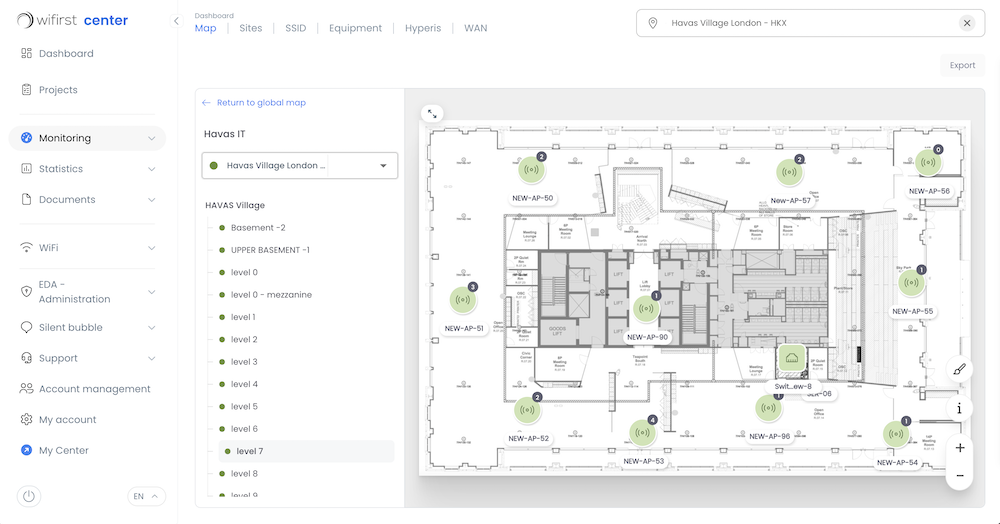
| Management | Reactive (Reboot when broken) | Proactive AI Monitoring (NOC 24/7) |
Modern Challenges: Density, Security & Green IT
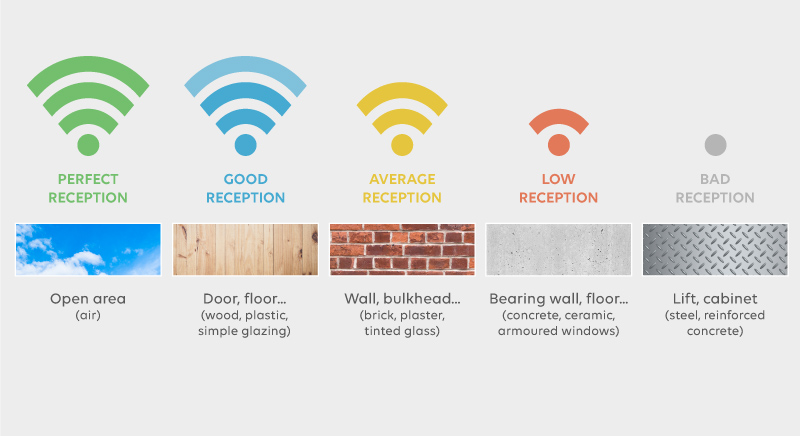
- The "All-Wireless" Office: With the decline of Ethernet ports, WiFi must deliver wired-like reliability for video calls (Teams/Zoom) and cloud apps.
- Cybersecurity Threats: Ransomware targets networks. Business WiFi must act as the first line of defense with IDS/IPS (Intrusion Detection/Prevention Systems).
- Sustainability (Green IT): Companies now require energy-efficient networks. Advanced APs can now sleep during off-hours to reduce carbon footprint.
- IoT Explosion: Smart buildings (sensors, locks, HVAC) require dedicated, isolated SSIDs to prevent security breaches from vulnerable devices.
Key Criteria to Choose a Business WiFi Provider
Selecting a partner is about more than just hardware. Look for:
- Technology Mastery: Are they deploying WiFi 7? Do they use AI for troubleshooting?
- End-to-End Responsibility: Do they manage the WAN (Fiber), the LAN (Switching), and the WLAN (WiFi)? A fragmented network is a fragile network.
- CSR Commitments: Can they provide data on the carbon footprint of your digital infrastructure?
- Proven SLAs: Demand a contractual Guarantee of Time to Repair (GTR), not just a response time.
Understanding the Landscape: Who Provides Business WiFi?
- Telcos (ISPs): Great for selling bandwidth (fiber), but often lack the agility and specialized engineering for complex LAN/WLAN optimization.
- Integrators (VARs): Good for one-off installations (CapEx), but they rarely offer proactive 24/7 monitoring or long-term performance guarantees.
- Managed Service Providers (MSPs) like Wifirst: The modern "As-a-Service" model. We combine the engineering depth of an integrator with the recurring service model of an operator. We take full responsibility for the network's lifecycle, from design to daily operations.
Managed WiFi vs DIY: The Total Cost of Ownership
DIY (Do-It-Yourself): Buying APs and managing them internally often leads to higher TCO due to hidden costs: training staff, software licensing, emergency troubleshooting, and hardware obsolescence.
Managed WiFi (OpEx): A subscription model transforms unpredictable IT costs into a flat monthly fee. It includes hardware refreshes (e.g., upgrading to WiFi 7), security patches, and 24/7 expert support, allowing your IT team to focus on business innovation.
Conclusion
In 2026, Business WiFi is the foundation of your digital strategy. It must be secure, sustainable, and self-healing.
As the European leader in WiFi as a Service, Wifirst connects thousands of businesses with a promise: we run the network, you run the business.