- Introduction Connectivity: from a convenience service to a critical standard
- Challenge no. 1 Absorbing the shock of density and intensive use
- Challenge no. 2 Delivering the "Just like home" experience
- Challenge no. 3 Network architecture: field reality before theory
- Challenge no. 4 Smart Building for economic and CSR performance
- Challenge no. 5 Simplifying operational management (The back-to-school nightmare)
- Challenge no. 6 Legal Risks and Cybersecurity
- Conclusion WiFi, the cornerstone of your CSR and sales strategy
Content provided by Wifirst, connectivity provider
 |
 |
 |
 |
 |
 |
 |
 |
 |
The observation: "Data-vore" consumption
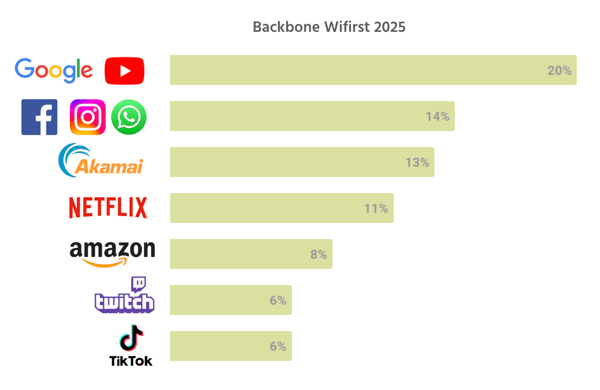
A 200-bed residence does not connect 200 devices, but potentially more than 1,000 connected objects simultaneously (Smartphones, PCs, Consoles, Speakers, TVs...). The usage profile has changed: it's no longer just about checking emails. In the evening, between 7 p.m. and 1 a.m., the network must simultaneously handle :
- 4K streaming (Netflix, YouTube and Twitch).
- Online gaming (which requires near-zero latency).
- HD video calls.
The solution: dedicated fiber (FTTO) and traffic management
Don't confuse consumer fiber (FTTH) with business fiber (FTTO). For a student residence, FTTH is a technical dead end in the medium term.
Why require dedicated fiber (FTTO)?
- Guaranteed, symmetrical throughput: unlike FTTH (shared, asymmetrical throughput), FTTO guarantees that 100% of the bandwidth is available 100% of the time.
- GTR 4H (Guaranteed Restoration Time): In the event of an outage, the operator makes a contractual commitment to repair in less than 4 hours. On FTTH, you may be cut off for several days.
- Smart QoS (Quality of Service): It's not enough to have a "big pipe". Network intelligence must prioritize real-time flows (video, gaming) to prevent one download from slowing down the whole residence.
The limitations of conventional public WiFi
On a standard public WiFi system, devices are isolated from each other for security reasons. As a result, a student can't get his phone to communicate with his connected speaker, printer or Chromecast. It's a frustrating experience, a far cry from the "home box".
The solution: the Room Area Network (RAN)
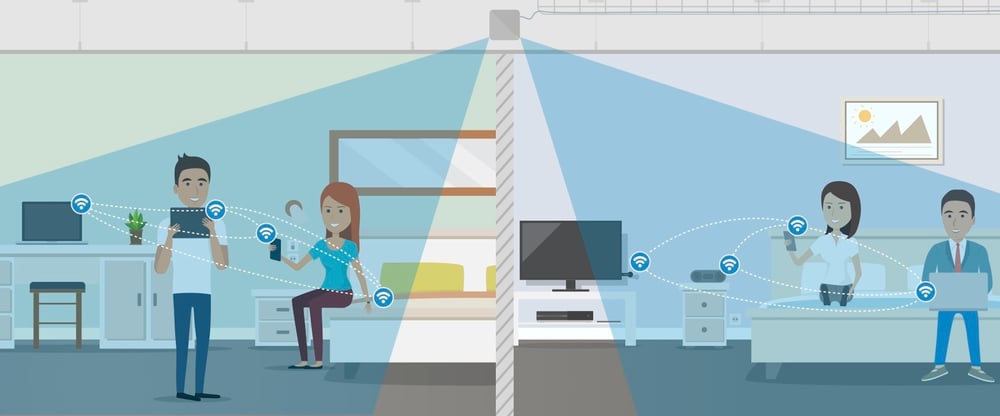
This is the major technological breakthrough of recent years. Wifirst deploys a patented technology that creates a "private connection bubble" (dynamic VLAN) for each room.
The benefits for students :
- Inter-device connection: He can "Caster" Netflix on his TV, print in WiFi or control his connected light bulbs.
- Total security: His bubble is invisible to his roommate.
- Seamless experience: He connects his devices just once and feels right at home.
The "post-development" Radio Audit
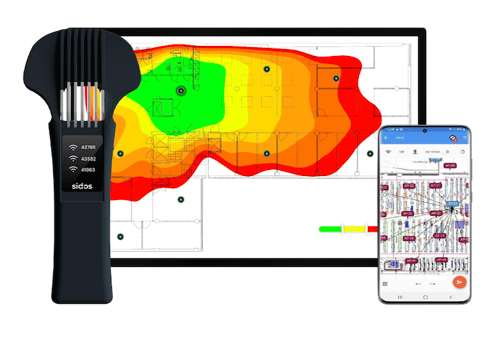
The only reliable verdict. Too many players size the network according to plan. This is a critical error. At Wifirst, terminal installation is only validated after an on-site audit in real-life conditions (after installation of partitions, fire doors and equipment). Why do we do this? Because a metal technical duct or a mirror stuck in the wrong place can block a signal.
Corridor or bedroom? A rational decision, not a dogmatic one.
-
The "Corridor" option (controlled density): This is possible and economical if the audit confirms that the partitions are permeable to waves. In this case, we impose strict rules: invisible terminals, installation under inspection hatches (30x30cm min.) for maintenance, and fine management of interference (co-channel interference).
-
The "In-Room" option (maximum capillarity): This becomes imperative in HQE/RE2020 buildings, where vibrated concrete and sound insulation act like Faraday cages. It's also the architecture of choice for guaranteeing the "Room Area Network" and connecting student objects at low transmitting power.
Observation: wasteful use of siloed networks
All too often, residences pile up networks: one line for student WiFi, another for video surveillance, a third for telephony, a fourth for BMS (Building Management System)... This "siloed" model multiplies subscription costs, maintenance and power consumption.
The solution: pooling on a single platform
The winning strategy is the converged LAN. A single, robust network irrigates the entire building and transports all flows in a watertight, secure manner.
Concrete benefits :
-
Financial savings (OPEX): a single subscription, a single maintenance.
-
Energy savings (CSR): replacing 100 individual boxes with 33 professional WiFi terminals reduces the infrastructure's electricity consumption by almost 90% (i.e. savings of around €1.30 per month per room).
-
Easier digitalization: this single base makes it easy to connect new IoT services: connected locks, smart laundries, temperature sensors, digital signage.
%20(1).png?width=800&height=565&name=B%C3%A2timent-connect%C3%A9-etudiant-UK%20(1)%20(1).png)
The bottom line: the administrator is not a network engineer
Managing incident tickets, hardware maintenance or captive portal "crashes" during the mass arrival of students in September is not your job. Managers waste precious time interfacing between different service providers.
The solution: total outsourcing and one-stop shopping
Your connectivity partner should act as an extension of your technical team.
-
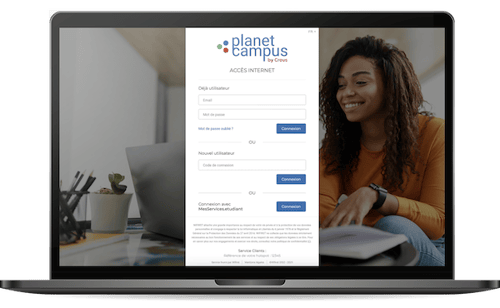
Self-onboarding: students must be able to sign up and log in on their own, in a matter of seconds, via a 100% digital pathway, even during the peak "Move-in Day" load.
-
Proactive supervision: a NOC (Network Operations Center) monitors your equipment 24/7 and intervenes even before students complain.
-
Single responsibility: a single point of contact for WiFi, fiber, video surveillance and VoIP telephony. No more "ping-pong" between suppliers in the event of a breakdown.