
- Introduction Hotel connectivity: the rules of the game have changed
- Challenge #1 Satisfying ever more demanding guests
- Challenge #2 Reconciling budget constraints and critical infrastructure
- Challenge #3 Network architecture: making the right choices before starting work
- Challenge #4 Managing a connected hotel
- Challenge #5 Turning connection into opportunity
- Challenge #6 Legal compliance and cybersecurity
- Conclusion The network, the cornerstone of your strategy
Content provided by Wifirst, connectivity provider
 |
 |
 |
 |
 |
 |
 |
 |
 |
The demand for seamless connectivity: the new hospitality standard
There’s no need to imagine travelers arriving with a suitcase full of gadgets. The reality is simpler, but just as demanding: every guest now carries at least two devices (smartphone plus a laptop or tablet) and expects them to connect instantly.
The real challenge for hoteliers is no longer just the number of devices, but a radical shift in expectations. Today’s guests have zero tolerance for:
- Connection dropouts: fatal during a professional Teams or Zoom call.
- Lag and buffering: a movie that stutters right in the middle of a relaxing evening.
- Fickle captive portals: having to re-authenticate every time you walk through the lobby.
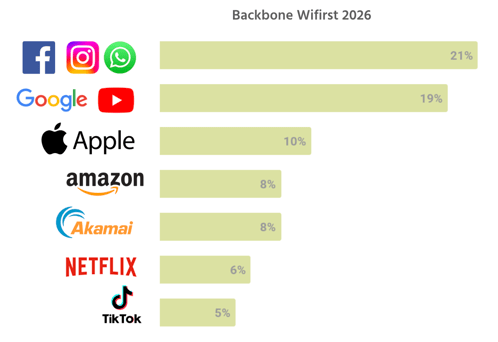
In the evening, as occupancy peaks, your network must simultaneously handle high-def streaming, remote work, and your own back-of-house needs (IPTV, smart room controls) without anyone noticing a slowdown.
Architecture built for peace of mind (yours and your guests')
The classic mistake is sizing a network for "average" use. A truly robust WiFi is built to handle the "rush hour"—that 7 PM peak—while guaranteeing long-term stability.
The pillars of a reliable infrastructure:
- Dedicated Fibre (FTTO): This is your guarantee of constant speed. Unlike consumer-grade shared fibre (FTTH), which fluctuates based on neighbourhood traffic, FTTO guarantees 100% of your bandwidth, 100% of the time. The real game-changer? A 4-hour Guaranteed Restoration Time (SLAs): if something goes wrong, you aren't left stranded.
- Smart QoS (Quality of Service): Think of this as your traffic controller. It automatically prioritises sensitive traffic (VoIP, video calls) so that a massive download in one room never ruins the experience for the rest of the hotel.
- WiFi 6 & WiFi 7: It’s not just about raw speed; these standards are designed for high-density environments. They eliminate interference and allow guests to move from the lobby to their room without ever losing their connection.
Avoiding the “off‑plan” network trap: real‑world building conditions always win
Too many hotel projects—whether new builds or major renovations—treat connectivity as an afterthought. The risk? Installing Access Points where it's convenient for the cabling, rather than where the signal actually needs to be. The result: "dead zones" appear the moment the furniture is moved in, leading to costly and frustrating remedial work after the grand opening.
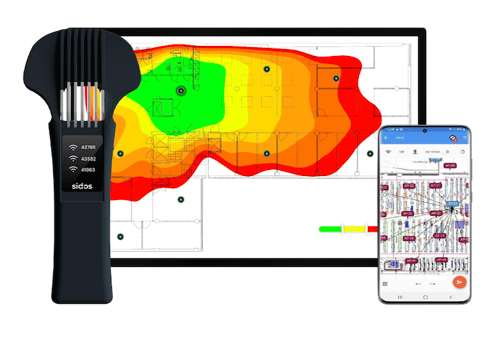
Modern building materials (HQE, RE2020 standards) are excellent for thermal insulation, but they act as shields against WiFi. A single fire door, a large mirror, or a poorly placed technical duct can be enough to kill a connection. WiFi performance shouldn't be a guessing game—it has to be measured.
The solution: on-site audits for flawless coverage
Real-world radio audits: At Wifirst, we don’t just trust the blueprints. We validate the placement of every Access Point with an on-site audit once the walls and fixtures are in place. This is the only way to guarantee that the signal reaches every corner of the room, including the bathroom and bedside.
Choosing the right architecture for your building:
- The "Corridor" approach (efficiency and discretion): A cost-effective, high-performance solution if your building’s structure allows the signal to pass through easily. It requires expert tuning to avoid interference between floors but offers easy maintenance without ever disturbing a guest in their room.
- The "In-Room" approach (maximum performance): Essential for highly insulated buildings or luxury establishments. By placing a dedicated Access Point in every room, you guarantee total stability for 4K streaming and a rock-solid foundation for smart room features (TVs, locks, IoT).
There is no "one-size-fits-all" solution. The right choice depends entirely on your architecture and your guests' expectations.
The "Tech Stack" tangle: how fragmented systems complicate your daily life
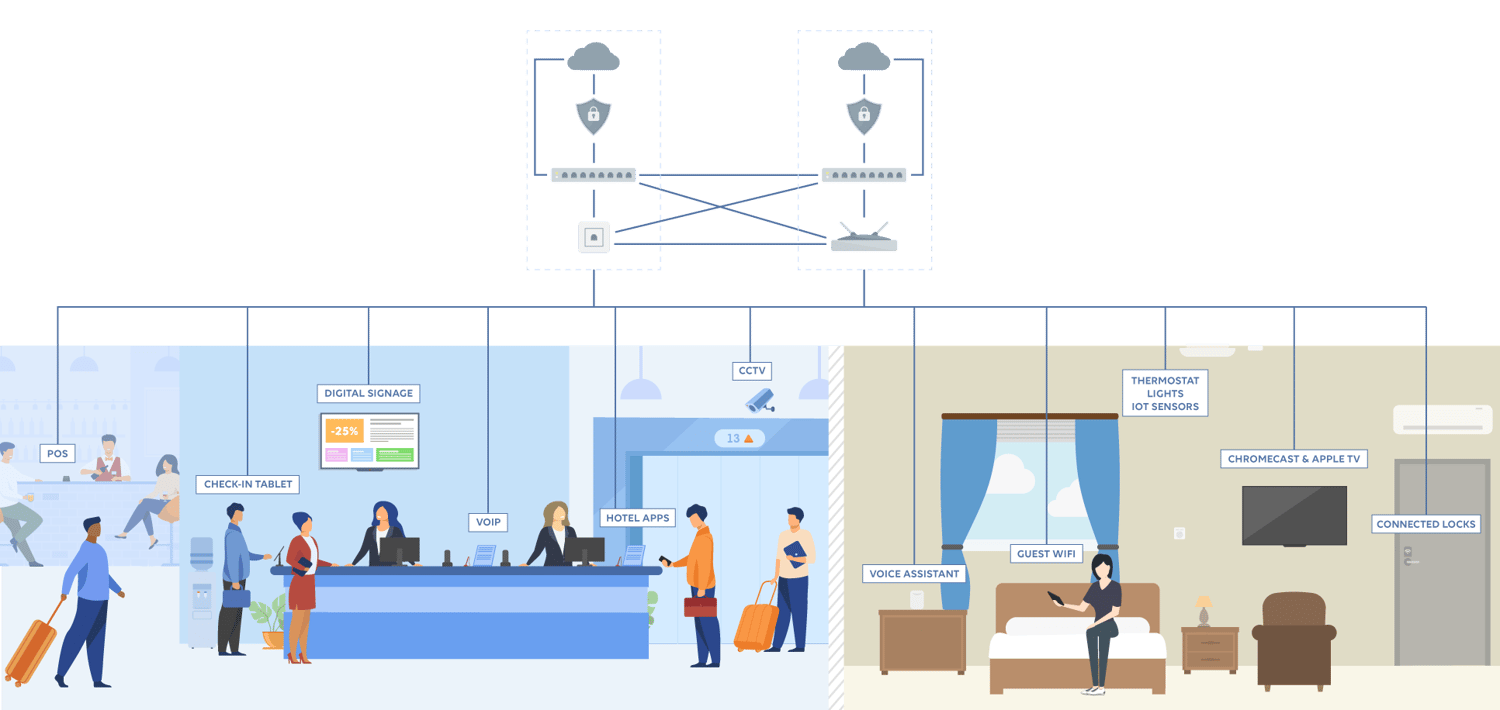
In many hotels, the network has grown in a disorganised way: one dedicated line for guest WiFi, another for CCTV, a third for telephony, not to mention smart room controls or building management. The result? A cluttered server room, a mountain of separate subscriptions, and an army of different vendors to manage.
This fragmented model is a constant source of stress. When a glitch occurs, precious time is wasted trying to figure out which provider to call, while everyone ends up finger-pointing. It’s an invisible drain on both your finances and your energy efficiency.
The solution: Converged LAN—one high-speed highway for all your services
The most effective strategy today is the Converged Managed LAN. The principle is simple: a single, ultra-secure infrastructure that intelligently carries all your data flows (WiFi, TV, CCTV, smart locks, and payment terminals). It becomes the central nervous system of your establishment.
The benefits for your hotel:
- Radical simplicity: One network, one contract, one single point of contact. You finally regain control of your infrastructure.
- Measurable savings (OPEX): By pooling equipment and hardware, you significantly reduce subscription and maintenance costs.
- Concrete CSR commitment: Less hardware means fewer electronic components and lower power consumption. This is a powerful argument for your green certifications (Green Key, ISO 14001) and your brand image.
- Future-proof operations: Thinking about adding mobile check-in or smart locks next year? Your network foundation is already in place, requiring no additional construction or cabling.
The reality: Free WiFi is a utility, the captive portal is an opportunity
Offering free WiFi is no longer a "perk"—it’s a basic amenity, just like fresh towels. But "free" shouldn’t mean a "cost center with no ROI." Most hotels treat the login portal as a mere technical hurdle, yet it is the only digital touchpoint used by 100% of your guests the moment they arrive.
Ignoring this touchpoint means leaving a gold mine of guest insights and marketing potential untapped.
The solution: Turn a simple login into a loyalty and revenue engine
A smart captive portal transforms a routine utility into a powerful brand interaction. This is where you reclaim the guest relationship that is so often intercepted by Online Travel Agencies (OTAs).
How a strategic portal boosts your bottom line:
- Driving loyalty program sign-ups: Follow the lead of industry giants: offer "Premium High-Speed" access as an exclusive perk for guests who log in with their loyalty account or sign up in one click. It is the most effective way to convert a transient guest into a lifetime member.
- Owning your data (First-party data): Collect guest emails (in full GDPR compliance) for your own future marketing. You are no longer dependent on the "anonymised" or limited data provided by third-party booking sites.
- Instant Upselling: The moment a guest connects is the perfect time to suggest a table at your restaurant, a spa treatment, or a "late check-out" offer—delivered directly to their screen when they are most engaged.
- Seamless PMS Integration: By syncing Wi-Fi with your Property Management System (PMS), guests are recognised instantly. No more clunky codes or paper slips: the connection is fluid, secure, and personalised to their stay.
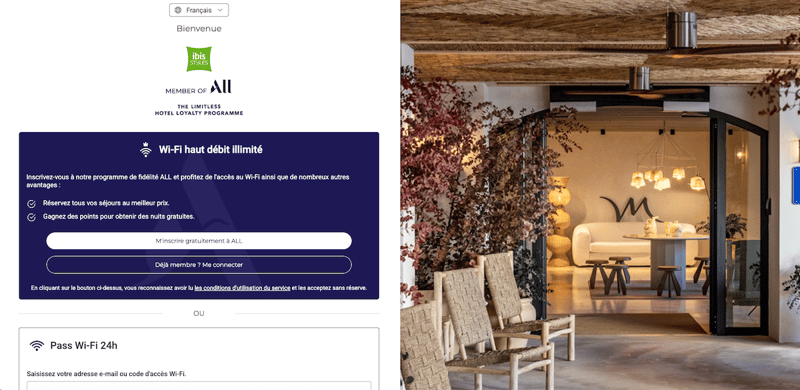
In short, your WiFi should do more than just "provide Internet"—it should be a tool to know your guests better, serve them better, and ensure they keep coming back.